Mirror Mirror On My Accent Wall

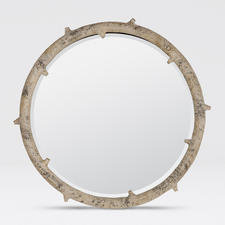
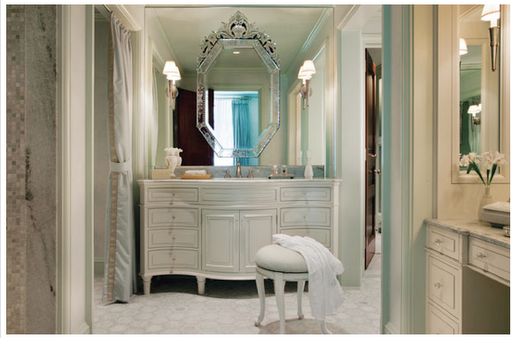
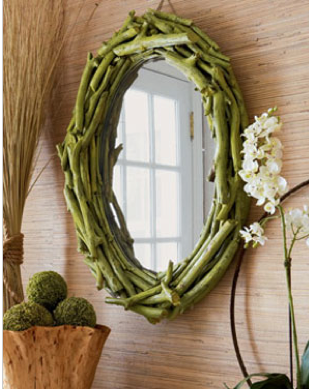
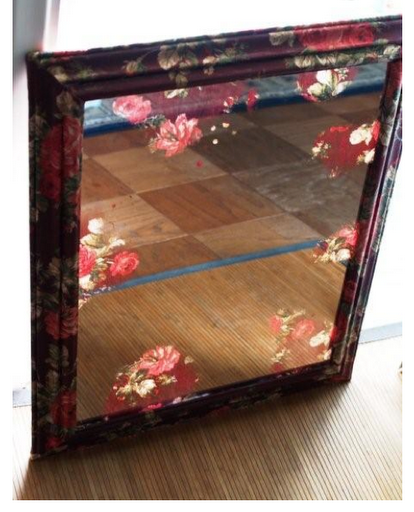
Mirror mirror on the wall, please help spruce up my home this fall. Sometimes putting a simple mirror on your wall can easily add that contemporary, traditional, country, or eclectic touch you’ve been trying to nail. Not only will they provide something cool to look at but by choosing the right frame shape and size you can reflect more light in a darker space and give the illusion that a room is larger/ higher in height.
But you don’t want just any ordinary mirror. MadeGoods is one of my new favorite sites to shop for accessories. Scan below to get a glimpse at a few of my favorites: 

But a word of caution.  Mirror hangers there’s a possibility that the slightly narcissistic people in your household may hog up “mirror time” which could lead to some nasty fights. Better hope that it doesn’t turn out like this scene from one of my favorite shows this season Once Upon A Time

Gold Leaf & Bronze Patina Mirror, 28″ or 18″
by Chole
Find at MadeGoods
Tarnished Silver Mirror, 20″
by Gigi
Find at MadeGoods

Light Oxidized Mirror, 40″
by Farah
Find at MadeGoods

Light Oxidized Mirror, 40″
by Farah
Find at MadeGoods

Light Oxidized Mirror, 40″
by Farah
Find at MadeGoods

Light Oxidized Mirror, 40″
by Farah
Find at MadeGoods

Coral White Mirror, 34″
by Serrat
Find at MadeGoods

White Faux Bois Mirror, 30″
by Xabier
Find at MadeGoods
Cream Shell Mirror, 36″
by Ava
Find at MadeGoods
Grotta Baroque Shell Pattern Mirror, 30″W x 38″H
Find at MadeGoods

Tip# : Try placing a mirror on a mirror. Really do it! The dimensions it adds to the environment 
Light Oxidized Mirror, 40″
by Farah
Find at MadeGoods

Innovative Ways to Recycle: Chopstick Sail Boat

Hey everyone I’m back at it again only this time I’ve decided to start a new series that shows the extent of human ingenuity in the way they use materials around them that just also happen to be sustainable. Check out these this cool cat.

1) Shuhei Ogawara and His Canoe Made From Disposable Chopsticks

Canoe made of chopsticks --

A former city employee in the Fukushima prefecture town of Koriyama has built a 4-meter (13-ft) long canoe from thousands of used disposable chopsticks recovered from the city hall cafeteria. Bothered that perfectly good wood was going to waste after a single use, Shuhei Ogawara — whose job at city hall involved working with the local forestry industry — spent the last two years of his career collecting used chopsticks from the cafeteria. An experienced canoe builder, Ogawara spent over 3 months gluing 7,382 chopsticks together into strips to form the canoe shell, to which he added a polyester resin coat. The canoe weighs about 30 kilograms (66 lbs), which is a bit heavier than an ordinary cedar canoe, but Ogawara is confident it will float. A launching ceremony is planned for May at nearby Lake Inawashiro.

[Source: Asahi]

Funny Stressed Induced Nightmare

Courtesy of my friends at XKCD A Webcomic of Romance, Sarcasm, Math, and Language, I found this funny little comic that is just too ironic that I had to share. It seems whenever I’m stressed this is exactly what happens! What is this about and why can’t I have dreams that are conducive to my current life! I guess I was just too serious of a student. Any thoughts?

stick figure comic four frames school college missed assignment
http://xkcd.com/557/ Image URL (for hotlinking/embedding): http://imgs.xkcd.com/comics/students.png

Cinderella Species: The Little Creatures of Nature Need Love Too

Oh Man!! The Proboscis Monkey


It is hard enough to raise funds to save a lion, it’s even harder to gather up support for a fly.  So, it comes to no surprise that many non-governmental wildlife organizations gear their save-a-species campaigns toward animals that are categorized by conservationists as flagship species. For clarification purposes, flagship species are animals that are big, attractive, and have forward facing eyes. (1) You know the types; those lovable polar bears, majestic tigers, and human-esque chimpanzees we see on our cereal boxes.  As a result, criticism is often directed toward this strategy not just because it overlooks smaller, uglier, and unfamiliar species; but because they generate the most financial support despite the animals’ status on the endangered species list.

According to Dr. Smith, author of a paper that was just published in the journal Conservation Letters, its not as easy as it seems:

“There are tradeoffs between how important a species is for conservation and how easy it is to get that funding…There’s always the question of how much money it would take to turn a slug into a flagship.”

Yet, despite the downfalls, it still appears to be an accomplishment for wildlife organizations.  Right? The situation is a bit more complicated.  Only about 80 out of 1098 the flagship category serve as poster-children for these organizations. By focusing conservation efforts on these select 80 species alone we lower the chance that a greater number of endangered animals are being saved. Add to the fact that many of these animals  live in ecological systems that are not necessarily high in bio-diversity; we could be doing a lot more. (1) As of now,  Dr. Smith and his colleagues have quantified that:

“Sixty-one percent of the fund-raising went towards conservation of the species itself rather than its larger habitat; only 2.2 percent used the flagship species as a means of raising the profile for the animal’s ecosystem as a whole. ”(1)

An article,“Inviting Cinderalla Species to the Ball,” by Rachel Nuwer, reveals how researchers are now working on shedding light on some of the lesser known flagship species. Their name for this new group: the Cinderella species. The Cinderella group is representative of their efforts to meet a middle ground. So essentially, these are unknown animals in the flagship category that are able to garter investments but also serve as keystone species in their bio-diverse habitats. While researchers realize they will never be as popular as the elephant or the panda, they are hoping to change organizations motives and people perceptions.

What would this mean for us donors? We should expect to be introduced to a potential 183 species like the Talmud bear cuscus, the Pennant’s red colobus, the Tamaraw or Mindoro dwarf buffalo the African wild ass and the pygmy raccoon.  We should also expect more flexibility  like the option to persevere landscapes as a whole rather than single species.(1)


Source:Nuwer, Rachel. “Inviting Cinderella Species to the Ball.” Green A Blog About Energy and the Environment. New York Times, 24 Apr. 2012. Web. 25 Apr. 2012. <http://green.blogs.nytimes.com/2012/04/24/inviting-cinderella-species-to-the-ball/?ref=earth&gt;.

Micro Farming in Small Spaces

Why not bring farming indoors with this great idea courtesy of the Martha Stewart Show. Its a great idea for  apartment living, company kitchens,  as well as a great way to get healthy products in the winter months.

Wouldn’t you love to eat home-grown salads? Growing your own food locally and organically not only provides you with healthier food — it tastes better.

Here’s a great idea for growing fresh, flavorful salad greens right at your backdoor: a salad table — basically, a shallow wooden frame with a mesh bottom. Plus, with legs attached, it allows you to grow great salad greens at waist level from April through November.

The salad table was designed in 2006 by University of Maryland gardening expert Jon Traunfeld, who got the idea from a metal version he saw being used on an organic farm in southern Maryland. Easy to construct and use, a salad table is portable, takes up little space, and is a great way to get into growing fresh food at home. Plus, it provides excellent growing conditions: The 3 1/2-inch depth is perfect for salad greens; the special growing medium allows for rapid growth; there are no weeds; and you’ll see few pest problems.

Salad tables can be used on decks, patios, backyards, courtyards, or driveways. In the mid-Atlantic region, the table should be kept in full sun from April 1 to June 15, moved into light shade from June 15 to September 15, and back to full sun from September 15 to December 1.

You can grow a variety of plants in a salad table. The plants that grow fastest and produce the biggest crops include lettuces (leaf, romaine, butterhead, etc.) and all types of broccoli (arugula, broccoli rabe, kale, mustard, and Asian greens such as mizuna and komatsuna). Chard, spinach, beet greens, and basil will also grow well, but slower. Bush green beans grow very well in the shallow frames. With a deeper frame, you can grow tomato, pepper, and cucumber.

One to two pounds of salad greens are routinely harvested per salad table — that’s about 11 square feet of space — at each cutting. You can cut greens that have reached between 4 and 6 inches in height about 25 to 40 days after sowing seeds. The plants re-grow and can be cut a second time three weeks after the first harvest. This can lead to 7 to 8 pounds of green beans per salad table during a three-week harvest.

Building a Salad Table
To build a salad table that’s 33 inches wide by 58 inches long, you will need the following tools and materials:

  • Untreated framing lumber: two 10-foot-long two-by-fours and two 12-foot-long two-by-fours
  • 2 1/2-inch galvanized deck screws
  • 3/8-inch staples
  • 1 pound of 1-inch roofing nails
  • 3-by-5-foot roll of aluminum window screening
  • 3-by-5-foot roll of 1/2-inch mesh hardware cloth (galvanized wire mesh; comes in a roll)
  • Handsaw
  • Hammer
  • Tape measure
  • Square
  • Tin snips
  • Staple gun
  • Drill

Salad Table How-To
1. Make the frame by taking two 58-inch two-by-fours and attaching them to two 30-inch two-by-fours with galvanized screws. The two interior cross pieces are attached 18 3/4-inches from each end of the long piece, making three equal sections.

2. Staple window screen on the outside bottom of the frame.

3. Center the hardware cloth over the window screen; pull it taught and staple to the frame bottom.

4. Nail roofing nails around the frame for added support.

For more information and step-by-step pictures of building a salad table, visit growit.umd.edu.

Soil
The best growing medium is 50 percent soilless mix and 50 percent high-quality compost. The commercial soilless mix usually contains peat, perlite, and vermiculite, but new organic soilless mixes contain coir (shredded coconut fibers) and rice hulls. Work water into the soilless mixes to get them moistened. Then, combine the soilless mix evenly with the compost and fill the frame to the top — it will settle some, and that’s fine.

Seeds
When choosing seeds to plant, try lettuces of different textures and colors. Jon Traunfeld really likes ‘Merlot’ for its rich red color, ‘Speckled Trout’ for its splashes of color, and ‘Cocarde.’ You can also find unusual mustard greens and kales with interesting textures and shapes, such as ‘Osaka Purple’ mustard and ‘Red Russian’ kale. Try growing three or four kinds of basil. You can find a good selection in your local retail stores, and there are many excellent mail-order companies.

To plant a salad table in rows, begin by taking the edge of a piece of wood, a ruler, or stick to make shallow furrows in the growing medium. They should be about 4 inches apart. Then, carefully sow the seeds so they are about 1 to 2 inches apart. Lightly cover the seeds and press down. Arugula and mustard green seeds are very small, black, and bouncy. Lettuce seeds are a little larger and they are either very light or very dark in color. The darker seeds are harder to see against the dark growing medium. Be prepared to thin plants after they come up so that they are 1 to 2 inches apart.

Care-Taking
Once your salad table has been planted, only water when the growing medium feels or looks dry. Once the plants are up and growing well, you can water them daily with about 1 gallon of water; it takes less than 1 minute to do this. The salad table does need to be fertilized, as there are not enough nutrients in the compost and soilless mix. Fertilize after the plants are up, and use 1/2 the label rate because the compost will supply some nutrients. You can use either a dry fertilizer or a liquid fertilizer, but the latter has to be applied more frequently. Good results have been seen with cottonseed meal and other dry organic fertilizers and Osmocote (chemical slow-release fertilizer).

Resources
Special thanks to Jon Traunfeld, director of the Home and Garden Information Center and state master gardener coordinator at the University of Maryland, for sharing this information. For more information on the Maryland Master Gardener Program, visit mastergardener.umd.edu. For more information on the Grow It Eat It campaign, dedicated to teaching and encouraging Marylanders to grow some of their own food, visit growit.umd.edu.

For more helpful gardening information, check out our vegetable garden center. Plus, show off your prized vegetables or vegetable garden by entering a photo in our vegetable garden contest.

Source: “Salad Table.” Marthastewart.com. Martha Stewart Show, Mar. 2009. Web. 04 Apr. 2012. <http://www.marthastewart.com/267317/salad-table>